OLS Regression II
Agenda
- Two continuous variables
- One continuous & one categorical variable
Learning objectives
By the end of the lecture, you will be able to …
- Use R to produce multivariate regression
- Use R to create publication ready regression tables (e.g., Table 02)
- Understand the concept of modelling, interpreting, and visualizing interaction effects and marginal predictions.
Code-along 09
Download and open code-along-09.qmd
Packages
Load the standard packages and new package modelbased.
Load your data
Variables
yearSurvey yeartvhoursHours per day watching tvrealrincR’s income in constant $ageAge of respondenteducRespondents highest edu credithrs1How many hours did you work last weekchildsHow many children have you ever had?polviewsThink of self as liberal or conservativesexRespondents sexmaritalR’s marital status
Make a df with only the (pretty) categorical and continuous variables we’ll analyze.
# Categorical Variables
my_cat <- gss_all |>
  select(id, year, polviews, sex, marital) |>
  zap_missing() |>
  mutate(
    polviews = as_factor(polviews),
    sex = as_factor(sex),
    marital = as_factor(marital)) |>
  droplevels()

# Continuous Variables
my_con <- gss_all |>
  select(id, year, tvhours, age, educ, hrs1, realrinc, childs) |>
  mutate(
    age = as.numeric(age),
    educ = as.numeric(educ),
    hrs1 = as.numeric(hrs1),
    realrinc = as.numeric(realrinc),
    childs = as.numeric(childs))

# Combine the two dataframes
my_data <- full_join(my_cat, my_con, by = c("year", "id")) # match by 2 vars
Two continuous variables
Have the average number of children changed over time?
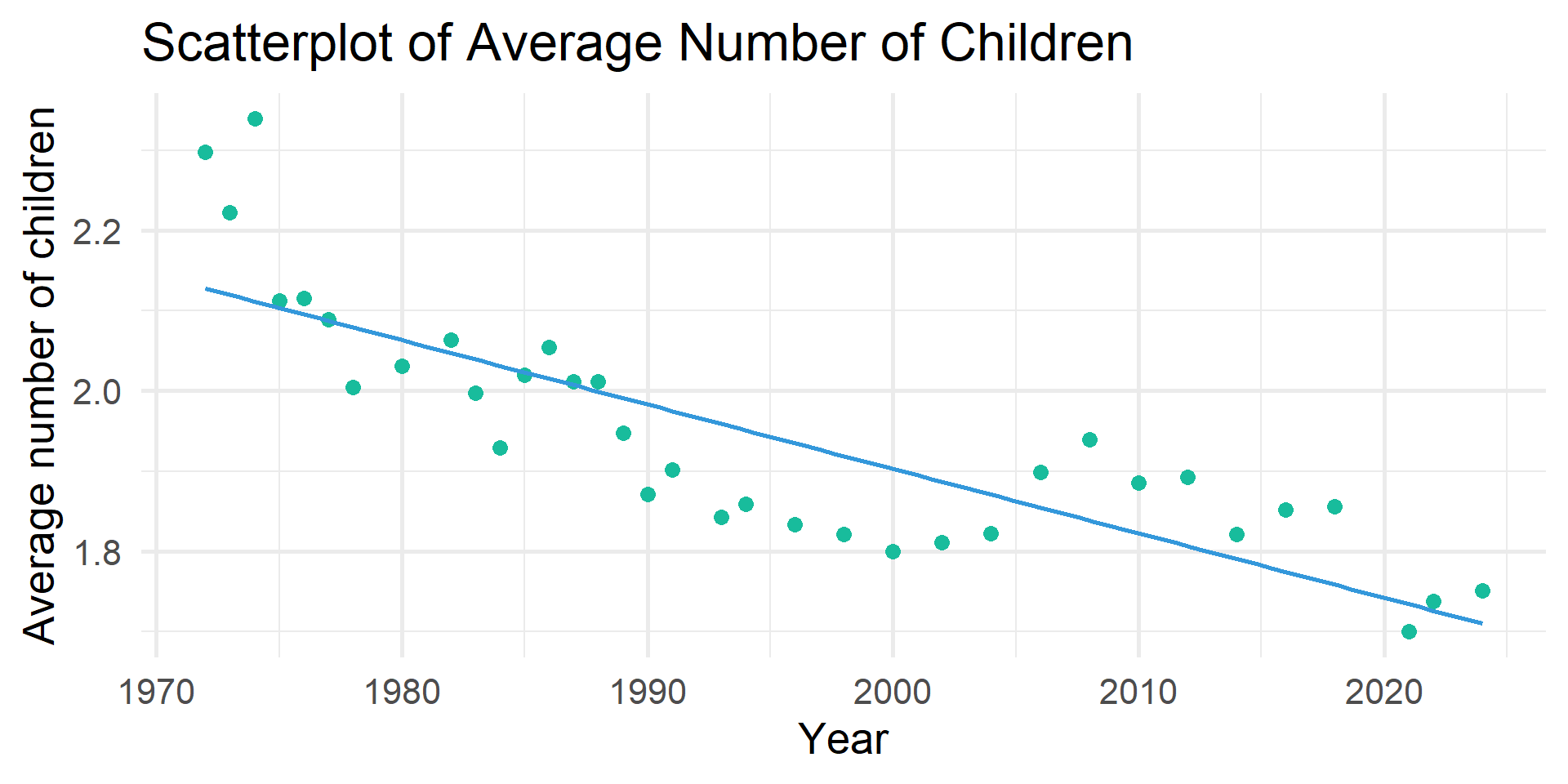
Simple Regression
# A tibble: 2 × 7
  term      estimate std_error statistic p_value lower_ci upper_ci
  <chr>        <dbl>     <dbl>     <dbl>   <dbl>    <dbl>    <dbl>
1 intercept   17.2       0.811      21.2       0   15.7     18.8
2 year        -0.008     0         -18.9       0   -0.008   -0.007
PRE Measure
Get \(r^2\)
# A tibble: 1 × 9
  r_squared adj_r_squared   mse  rmse sigma statistic p_value    df  nobs
      <dbl>         <dbl> <dbl> <dbl> <dbl>     <dbl>   <dbl> <dbl> <dbl>
1     0.005         0.005  3.07  1.75  1.75      357.       0     1 75407
Are the trends explained by increases in education?
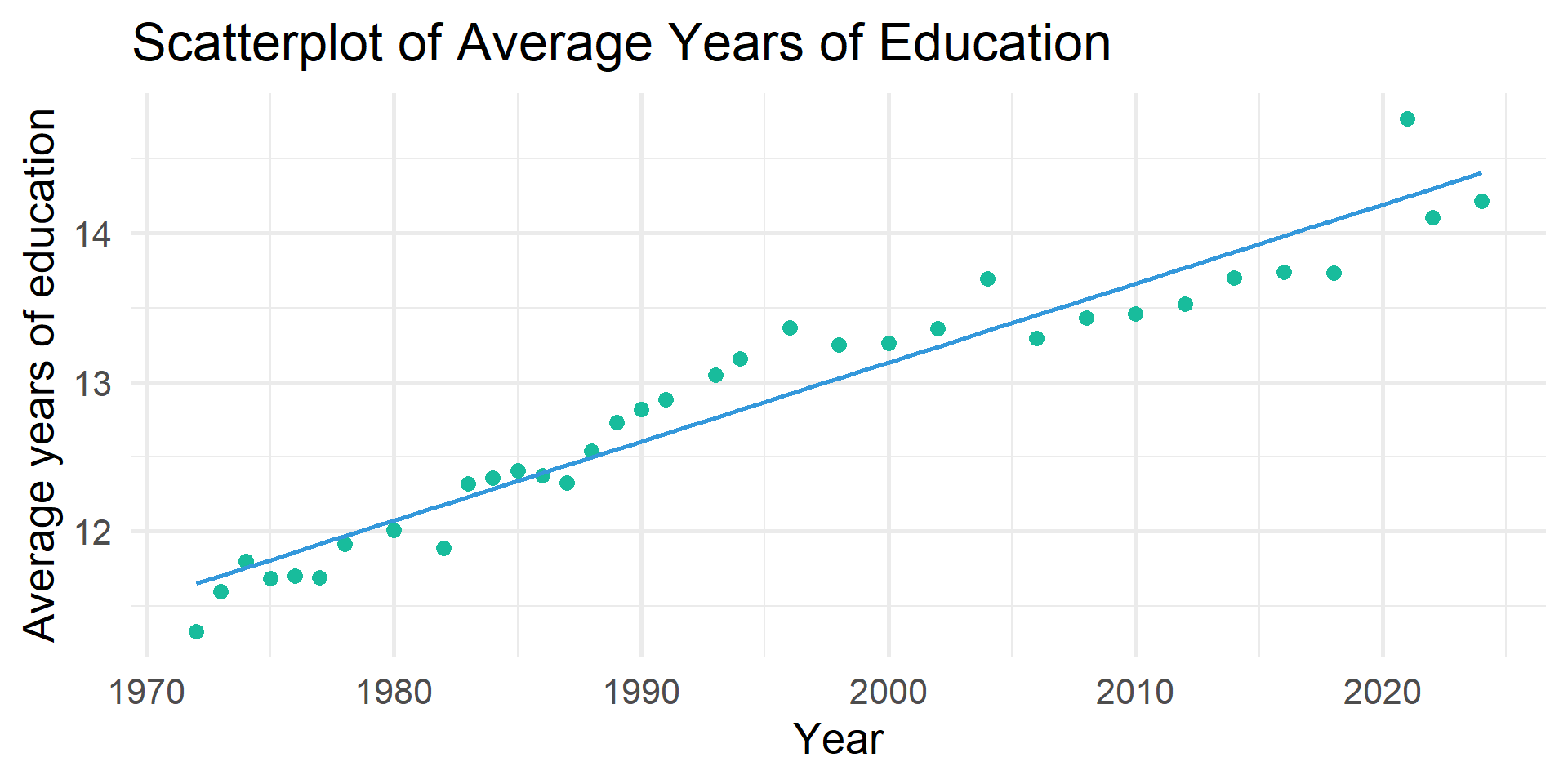
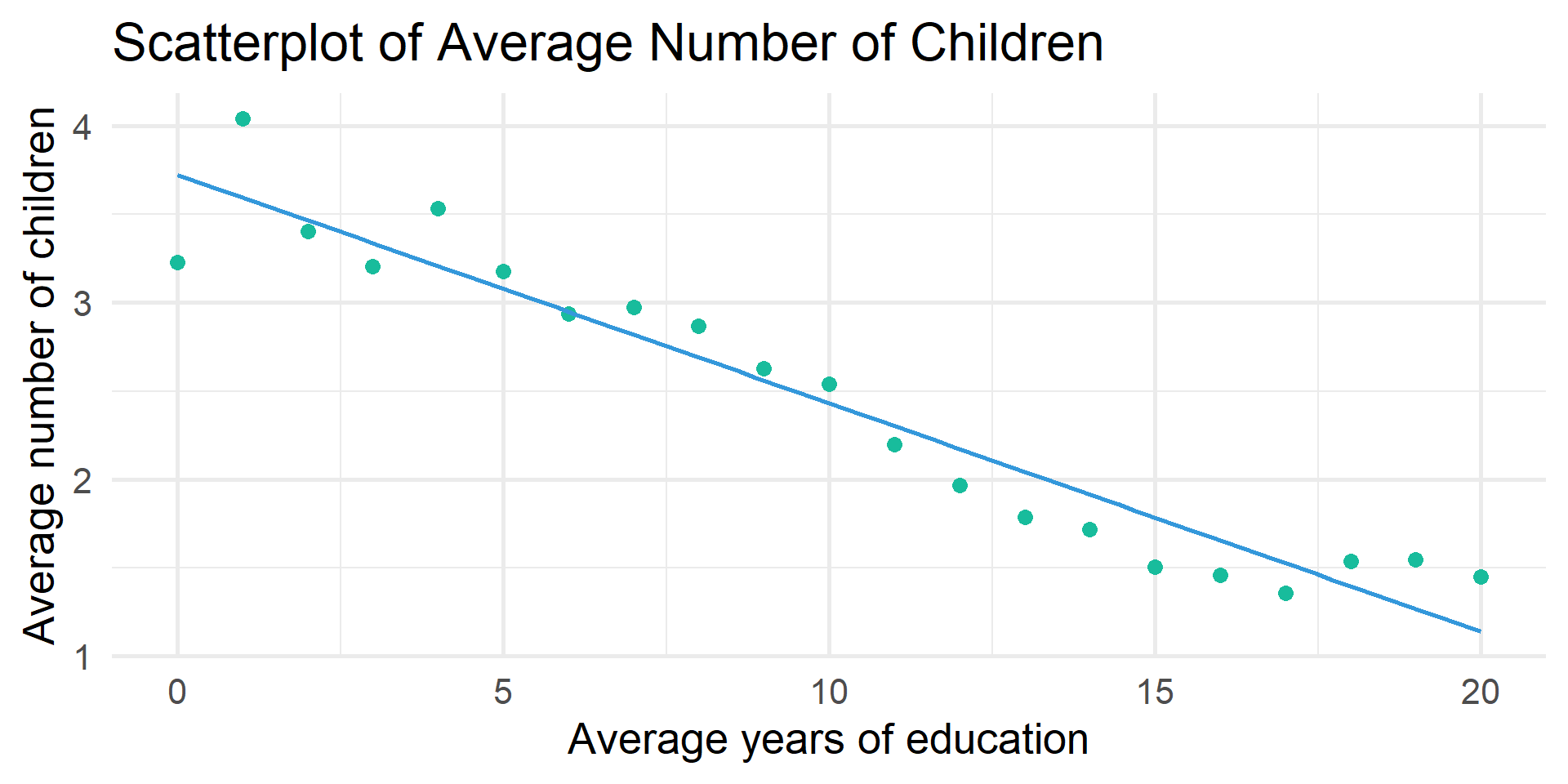
# A tibble: 2 × 7
  term      estimate std_error statistic p_value lower_ci upper_ci
  <chr>        <dbl>     <dbl>     <dbl>   <dbl>    <dbl>    <dbl>
1 intercept   17.2       0.811      21.2       0   15.7     18.8
2 year -0.008 0 -18.9 0 -0.008 -0.007# A tibble: 3 × 7
term estimate std_error statistic p_value lower_ci upper_ci
<chr> <dbl> <dbl> <dbl> <dbl> <dbl> <dbl>
1 intercept 5.26 0.813 6.47 0 3.66 6.85
2 year -0.001 0 -2.00 0.045 -0.002 0
3 educ -0.131 0.002 -64.5 0 -0.134 -0.127Change in PRE Measure
# A tibble: 1 × 9
  r_squared adj_r_squared   mse  rmse sigma statistic p_value    df  nobs
      <dbl>         <dbl> <dbl> <dbl> <dbl>     <dbl>   <dbl> <dbl> <dbl>
1 0.005 0.005 3.07 1.75 1.75 357. 0 1 75407tbl_regression()
OLS Regression predicting number of children by survey year and years of education
| Characteristic | Beta | 95% CI | p-value |
|---|---|---|---|
| (Intercept) | 5.3 | 3.7, 6.9 | <0.001 |
| GSS year for this respondent | 0.00 | 0.00, 0.00 | 0.045 |
| educ | -0.13 | -0.13, -0.13 | <0.001 |
| Abbreviation: CI = Confidence Interval | |||
tbl_regression()
OLS Regression predicting number of children by survey year and years of education
| Characteristic | Beta | SE | p-value |
|---|---|---|---|
| (Intercept) | 5.3 | 0.813 | <0.001 |
| GSS year for this respondent | 0.00 | 0.000 | 0.045 |
| educ | -0.13 | 0.002 | <0.001 |
| Abbreviations: CI = Confidence Interval, SE = Standard Error | |||
tbl_regression()
OLS Regression predicting number of children by survey year and years of education
| Characteristic | Beta1 | SE |
|---|---|---|
| (Intercept) | 5.3*** | 0.813 |
| GSS year for this respondent | 0.00* | 0.000 |
| educ | -0.13*** | 0.002 |
| R² | 0.057 | |
| No. Obs. | 75,166 | |
| 1 p<0.05; p<0.01; p<0.001 | ||
1 continuous variable & 1 categorical variable
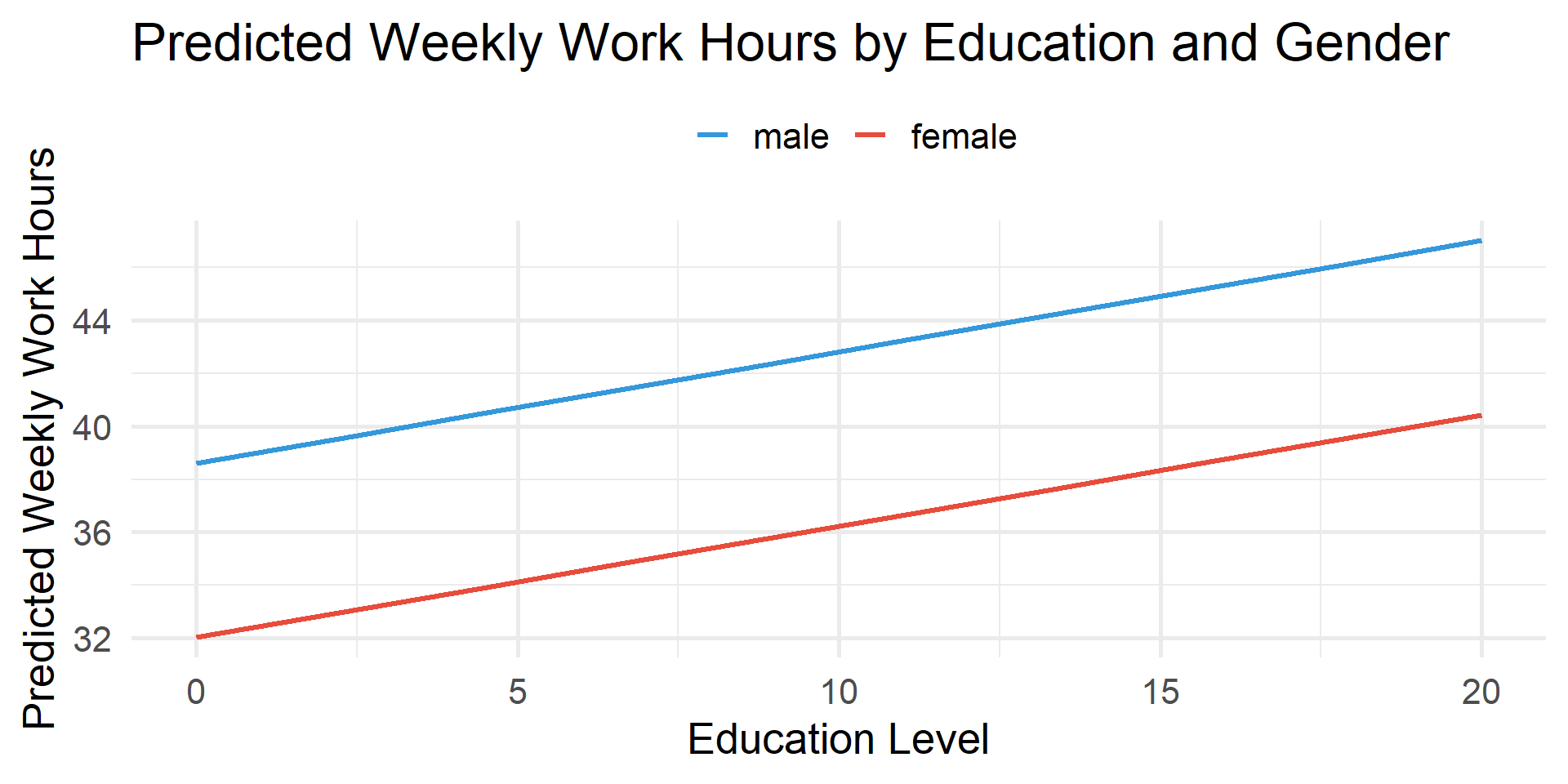
Are weekly hours worked related to education and gender?
# A tibble: 3 × 7
  term        estimate std_error statistic p_value lower_ci upper_ci
  <chr>          <dbl>     <dbl>     <dbl>   <dbl>    <dbl>    <dbl>
1 intercept      38.6      0.32      121.        0   38.0     39.2
2 educ            0.42     0.022      18.7       0    0.376    0.464
3 sex: female    -6.58     0.132     -49.9       0   -6.83    -6.32
tbl_regression()
OLS Regression predicting weekly work hours by years of education and gender
| Characteristic | Beta1 | SE |
|---|---|---|
| (Intercept) | 39*** | 0.320 |
| educ | 0.42*** | 0.022 |
| sex | ||
| male | — | — |
| female | -6.6*** | 0.132 |
| R² | 0.061 | |
| No. Obs. | 43,167 | |
| 1 p<0.05; p<0.01; p<0.001 | ||
tbl_regression()
OLS Regression predicting weekly work hours by years of education and gender
| Characteristic | Beta1 | SE |
|---|---|---|
| (Intercept) | 39*** | 0.320 |
| educ | 0.42*** | 0.022 |
| Women | -6.6*** | 0.132 |
| R² | 0.061 | |
| No. Obs. | 43,167 | |
| 1 p<0.05; p<0.01; p<0.001 | ||
estimate_means()
# A tibble: 2 × 7
  sex     Mean     SE CI_low CI_high     t    df
  <fct>  <dbl>  <dbl>  <dbl>   <dbl> <dbl> <int>
1 male    44.4 0.0923   44.2    44.5  480. 43164
2 female 37.8 0.0939 37.6 38.0 402. 43164estimate_means()
estimate_means()
\(\color{#18bc9c}{38.601} + \color{#fd7e14}{0.420}_{educ} - \color{#e74c3c}{6.576}_{female}\)
# A tibble: 6 × 8
   educ sex     Mean    SE CI_low CI_high     t    df
  <dbl> <fct>  <dbl> <dbl>  <dbl>   <dbl> <dbl> <int>
1  0    male    38.6 0.320   38.0    39.2 121.  43164
2  0    female  32.0 0.323   31.4    32.7  99.0 43164
3  2.22 male    39.5 0.273   39.0    40.1 145.  43164
4  2.22 female  33.0 0.276   32.4    33.5 119.  43164
5  4.44 male    40.5 0.226   40.0    40.9 179.  43164
6  4.44 female  33.9 0.230   33.4    34.3 148.  43164
men with 0 years of education = \(\color{#18bc9c}{38.601} + \color{#fd7e14}{0.420}_{educ}*0\)
women with 0 years of education \(\color{#18bc9c}{38.601} + \color{#fd7e14}{0.420}_{educ}*0 -\color{#e74c3c}{6.576}_{female}\)
men with 2.222 years of education \(\color{#18bc9c}{38.601} + \color{#fd7e14}{0.420}_{educ}*2.222\)
women with 2.222 years of education \(\color{#18bc9c}{38.601} + \color{#fd7e14}{0.420}_{educ}*2.222-\color{#e74c3c}{6.576}_{female}\)
Are weekly hours worked related to education and marital status?
# A tibble: 6 × 7
  term                   estimate std_error statistic p_value lower_ci upper_ci
  <chr>                     <dbl>     <dbl>     <dbl>   <dbl>    <dbl>    <dbl>
1 intercept                36.5       0.33    110.      0       35.9     37.1
2 educ                      0.378     0.023    16.4     0        0.333    0.424
3 marital: widowed         -5.94      0.385   -15.4     0       -6.70    -5.19
4 marital: divorced         0.605     0.198     3.06    0.002    0.218    0.993
5 marital: separated       -0.278     0.379    -0.733   0.464   -1.02     0.465
6 marital: never married   -1.76      0.163   -10.8     0       -2.08    -1.44
Regression Predicting Weekly Work Hours by Years of Education and Marital Status
model |>
  tbl_regression(
    intercept = TRUE,
    label = list(
      marital = "Marital status (ref. = married)")) |>
  remove_row_type(type = c("reference")) |>
  modify_column_hide(conf.low) |>
  modify_column_unhide(
    column = std.error) |>
  remove_abbreviation() |>
  add_significance_stars() |>
  add_glance_table(
include = c("r.squared", "nobs"))| Characteristic | Beta1 | SE |
|---|---|---|
| (Intercept) | 37*** | 0.330 |
| educ | 0.38*** | 0.023 |
| Marital status (ref. = married) | ||
| widowed | -5.9*** | 0.385 |
| divorced | 0.61** | 0.198 |
| separated | -0.28 | 0.379 |
| never married | -1.8*** | 0.163 |
| R² | 0.015 | |
| No. Obs. | 43,178 | |
| 1 p<0.05; p<0.01; p<0.001 | ||
Are daily TV hours related to education and political identity?
my_data <- my_data %>%
  mutate(pol_group = case_when(
    polviews %in% c("extremely liberal", "liberal", "slightly liberal") ~ "Liberal",
    polviews == "moderate, middle of the road" ~ "Moderate",
    polviews %in% c("slightly conservative", "conservative", "extremely conservative") ~ "Conservative",
    TRUE ~ NA_character_))

model <- lm(tvhours ~ educ + pol_group, data = my_data)

get_regression_table(model)
# A tibble: 4 × 7
term estimate std_error statistic p_value lower_ci upper_ci
<chr> <dbl> <dbl> <dbl> <dbl> <dbl> <dbl>
1 intercept 5.00 0.056 89.1 0 4.89 5.12
2 educ -0.159 0.004 -40.4 0 -0.166 -0.151
3 pol_group: Liberal 0.157 0.031 5.15 0 0.097 0.217
4 pol_group: Moderate 0.192 0.028 6.76 0 0.136 0.247relevel()
# A tibble: 4 × 7
  term                    estimate std_error statistic p_value lower_ci upper_ci
  <chr>                      <dbl>     <dbl>     <dbl>   <dbl>    <dbl>    <dbl>
1 intercept                  5.20      0.054     96.4     0       5.09     5.30
2 educ                      -0.159     0.004    -40.4     0      -0.166   -0.151
3 pol_group: Conservative   -0.192     0.028     -6.76    0      -0.247   -0.136
4 pol_group: Liberal        -0.035     0.03      -1.15    0.25   -0.093    0.024
Does the relationship between TV hours and education differ by political identity?
# A tibble: 6 × 7
  term                    estimate std_error statistic p_value lower_ci upper_ci
  <chr>                      <dbl>     <dbl>     <dbl>   <dbl>    <dbl>    <dbl>
1 intercept                  4.98      0.088    56.5     0        4.81     5.16
2 educ                      -0.142     0.007   -21.1     0       -0.155   -0.129
3 pol_group: Conservative   -0.1       0.128    -0.781   0.435   -0.351    0.151
4 pol_group: Liberal         0.553     0.132     4.20    0        0.295    0.811
5 educ:pol_groupConserva…   -0.008     0.01     -0.787   0.431   -0.026    0.011
6 educ:pol_groupLiberal -0.044 0.01 -4.55 0 -0.063 -0.025# Get predicted values
preds <- estimate_means(model, by = c("educ", "pol_group"))
# Plot using ggplot2
preds |>
ggplot(aes(x = educ, y = Mean, color = pol_group)) +
geom_line(linewidth = 1.2) +
labs(
title = "Predicted Daily TV Hours by Education and Political Identity",
x = "Education Level",
y = "Predicted TV Hours",
color = "Political Identity") +
theme_minimal(20) +
theme(legend.position = "top")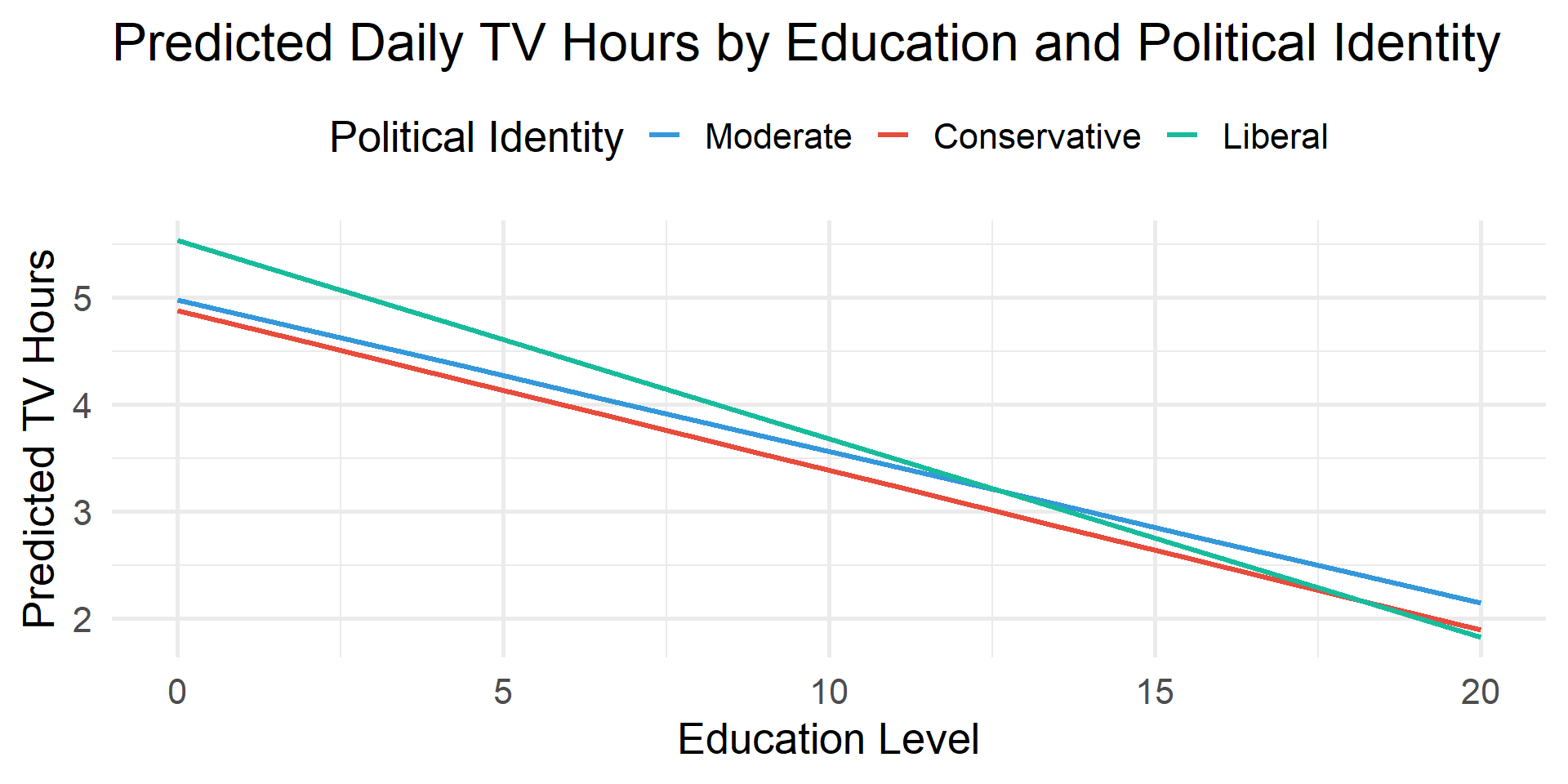
Think Like a Statistician
Think Like a Statistician
1. Run and interpret a regression predicting realrinc with hrs1 and educ
# A tibble: 3 × 7
  term      estimate std_error statistic p_value lower_ci upper_ci
  <chr>        <dbl>     <dbl>     <dbl>   <dbl>    <dbl>    <dbl>
1 intercept  -33065.     802.      -41.2       0  -34637.  -31494.
2 hrs1          481.      10.5      45.6       0     460.     501.
3 educ         2746.      50.4      54.5       0    2647.    2845.
Think Like a Statistician
2. Add childs to the regression. Interpret the output.
# A tibble: 4 × 7
  term      estimate std_error statistic p_value lower_ci upper_ci
  <chr>        <dbl>     <dbl>     <dbl>   <dbl>    <dbl>    <dbl>
1 intercept  -39248.     851.      -46.1       0  -40917.  -37580.
2 hrs1          481.      10.5      45.8       0     460.     501.
3 educ         2959.      51.2      57.8       0    2858.    3059.
4 childs       1960.      93.9      20.9       0    1776.    2144.
Think Like a Statistician
3. Add marital to the regression. Interpret the output.
# A tibble: 8 × 7
  term                   estimate std_error statistic p_value lower_ci upper_ci
  <chr>                     <dbl>     <dbl>     <dbl>   <dbl>    <dbl>    <dbl>
1 intercept               -33122.     886.     -37.4        0  -34859.  -31385.
2 hrs1                       468.      10.5     44.7        0     448.     489.
3 educ                      2888.      51.0     56.6        0    2788.    2988.
4 childs                    1021.     105.       9.76       0     816.    1226.
5 marital: widowed         -4122.     826.      -4.99       0   -5740.   -2503.
6 marital: divorced        -4029.     420.      -9.60       0   -4851.   -3206.
7 marital: separated       -5769.     816.      -7.07       0   -7368.   -4171.
8 marital: never married   -8792.     394.     -22.3        0   -9564.   -8020.