Statistical Tests II
Agenda
- \(chi^2\) Test
- Pearson’s Correlation Coefficient (R)
Learning objectives
By the end of the lecture, you will be able to …
- Use R to calculate chi-square tests
- Use R to calculate Pearson’s Correlation Coefficient (R)
Knowledge Check
Which of the following expressions correctly checks if a is equal to b in R?
- a == b
- a = b
- a <= b
- a |> b
Which of the following best describes the benefit of using pipes in dplyr?
- Pipes help chain multiple operations in a readable sequence.
- Pipes make code shorter but harder to read.
- Pipes allow you to write loops more efficiently.
- Pipes automatically optimize your code for speed.
What does the filter() function do in dplyr?
- It converts character variables to factors.
- It removes columns with missing values.
- It selects specific columns from a data frame.
- It keeps rows that meet a specified condition.
Which of the following uses mutate() correctly to create a new column called income_level?
- mutate(income_level <- income > 50000)
- mutate(income_level = filter(income > 50000))
- mutate(income_level = select(income))
- mutate(income_level = income > 50000)
Code-along 06
Download and open code-along-06.qmd
Packages
Load the standard packages & 1 new package: gtsummary()
Load your data
Variables
fefamBetter for man to work, woman tend homepostlifeBelief in life after death
lifenowR’s rating of life overall now from 0-10premarsxSex before marriageagekdbrnR’s age when 1st child bornsexRespondents sexeducRespondents highest edu creditageAge of respondentpolviewsThink of self as liberal or conservative
Variable Management
Make a df with only the (pretty) categorical and continuous variables we’ll analyze.
# Categorical Variables
my_cat <- gss22 |>
  select(id, premarsx, fefam, postlife, sex, polviews) |>
  zap_missing() |>
  as_factor() |>
  droplevels()

# Continuous Variables
my_con <- gss22 |>
  select(id, age, educ, lifenow, agekdbrn) |>
  mutate(
    age = as.numeric(age),
    educ = as.numeric(educ),
    lifenow = as.numeric(lifenow),
    agekdbrn = as.numeric(agekdbrn))

# Combine the two dataframes
my_data <- left_join(my_cat, my_con, by = "id")
\(chi^2\) Test
\(chi^2\) test
\(chi^2\) determines if categorical variables are related
Tests if the rows and columns in a two-way table are independent
\(chi^2\) in action
The news has been reporting a large gender difference in attitudes about gender roles.
You evaluate this narrative using the variable fefam:
It is much better for everyone involved if the man is the achiever outside the home and the woman takes care of the home and family.
How do you test your hypothesis?
Which of these equations represents your research hypothesis?
- There is no association between gender identity and attitudes about gender roles (statistically independent).
- Gender identity and attitudes about gender roles are related in the population (statistically independent).
- Gender identity and attitudes about gender roles are related in the population (statistically dependent).
Which of these equations represents your null hypothesis?
- There is no association between gender identity and attitudes about gender roles (statistically independent).
- Gender identity and attitudes about gender roles are related in the population (statistically independent).
- There is no association between gender identity and attitudes about gender roles (statistically dependent).
Review: Pretty cross-tab
Use summarytools::ctable
- 1
-
Change from
table()toctable(). - 2
- The “c” gives column %; “r” would give row %.
- 3
- This adds the % symbols to the table.
- 4
- Exclude the missing levels from the table.
Cross-Tabulation, Column Proportions
fefam * sex
Data Frame: my_data

------------------- ----- --------------- --------------- ---------------
                      sex            male          female           Total
              fefam
     strongly agree           87 (  6.8%)     84 (  5.8%)    171 (  6.3%)
              agree          292 ( 22.9%)    221 ( 15.3%)    513 ( 18.9%)
           disagree          573 ( 44.9%)    602 ( 41.6%)   1175 ( 43.2%)
  strongly disagree          323 ( 25.3%)    539 ( 37.3%)    862 ( 31.7%)
              Total         1275 (100.0%)   1446 (100.0%)   2721 (100.0%)
------------------- ----- --------------- --------------- ---------------
Pretty cross-tab (new)
Now that we know how to use the dplyr |>!
sex
|
Total | ||
|---|---|---|---|
| male | female | ||
| fefam | |||
| strongly agree | 87 (6.8%) | 84 (5.8%) | 171 (6.3%) |
| agree | 292 (23%) | 221 (15%) | 513 (19%) |
| disagree | 573 (45%) | 602 (42%) | 1,175 (43%) |
| strongly disagree | 323 (25%) | 539 (37%) | 862 (32%) |
| Total | 1,275 (100%) | 1,446 (100%) | 2,721 (100%) |
Pretty cross-tab with p-value
sex
|
Total | ||
|---|---|---|---|
| male | female | ||
| fefam | |||
| strongly agree | 87 (6.8%) | 84 (5.8%) | 171 (6.3%) |
| agree | 292 (23%) | 221 (15%) | 513 (19%) |
| disagree | 573 (45%) | 602 (42%) | 1,175 (43%) |
| strongly disagree | 323 (25%) | 539 (37%) | 862 (32%) |
| Total | 1,275 (100%) | 1,446 (100%) | 2,721 (100%) |
| Pearson’s Chi-squared test, p<0.001 | |||
Which of these statements best summarizes your conclusion?
- Our findings prove that gender identity has no effect on attitudes about gender roles
- Since the p-value is above 0.05, we can conclude that gender identity strongly influences attitudes about gender roles.
- We find no statistically significant relationship between gender identity and attitudes about gender roles.
Caution: size matters
sex
|
Total | ||
|---|---|---|---|
| male | female | ||
| fefam | |||
| strongly agree | 3 (7.5%) | 3 (6.3%) | 6 (6.8%) |
| agree | 11 (28%) | 6 (13%) | 17 (19%) |
| disagree | 19 (48%) | 19 (40%) | 38 (43%) |
| strongly disagree | 7 (18%) | 20 (42%) | 27 (31%) |
| Total | 40 (100%) | 48 (100%) | 88 (100%) |
| Fisher’s exact test, p=0.065 | |||
Review: t.test() with proportions
# Use logic to recode factor as mean (yes = 1; no: 2 = 0)
my_data$ghosts <- ifelse(my_data$postlife == "yes", 1, 0)

# t.test
t.test(my_data$ghosts ~ my_data$sex, alternative = "two.sided")
    Welch Two Sample t-test

data:  my_data$ghosts by my_data$sex
t = -5.4996, df = 1418.2, p-value = 4.51e-08
alternative hypothesis: true difference in means between group male and group female is not equal to 0
95 percent confidence interval:
 -0.14739470 -0.06989112
sample estimates:
  mean in group male mean in group female
           0.7553763            0.8640193
t.test() & \(chi^2\)
Pearson’s Correlation Coefficient (R)
cor.test()
R is the correlation between two interval-ratio variables.
Heads Up!
Because Pearson’s R doesn’t require specifying an independent and dependent variable, the order of the variables does not matter.
Scatterplot
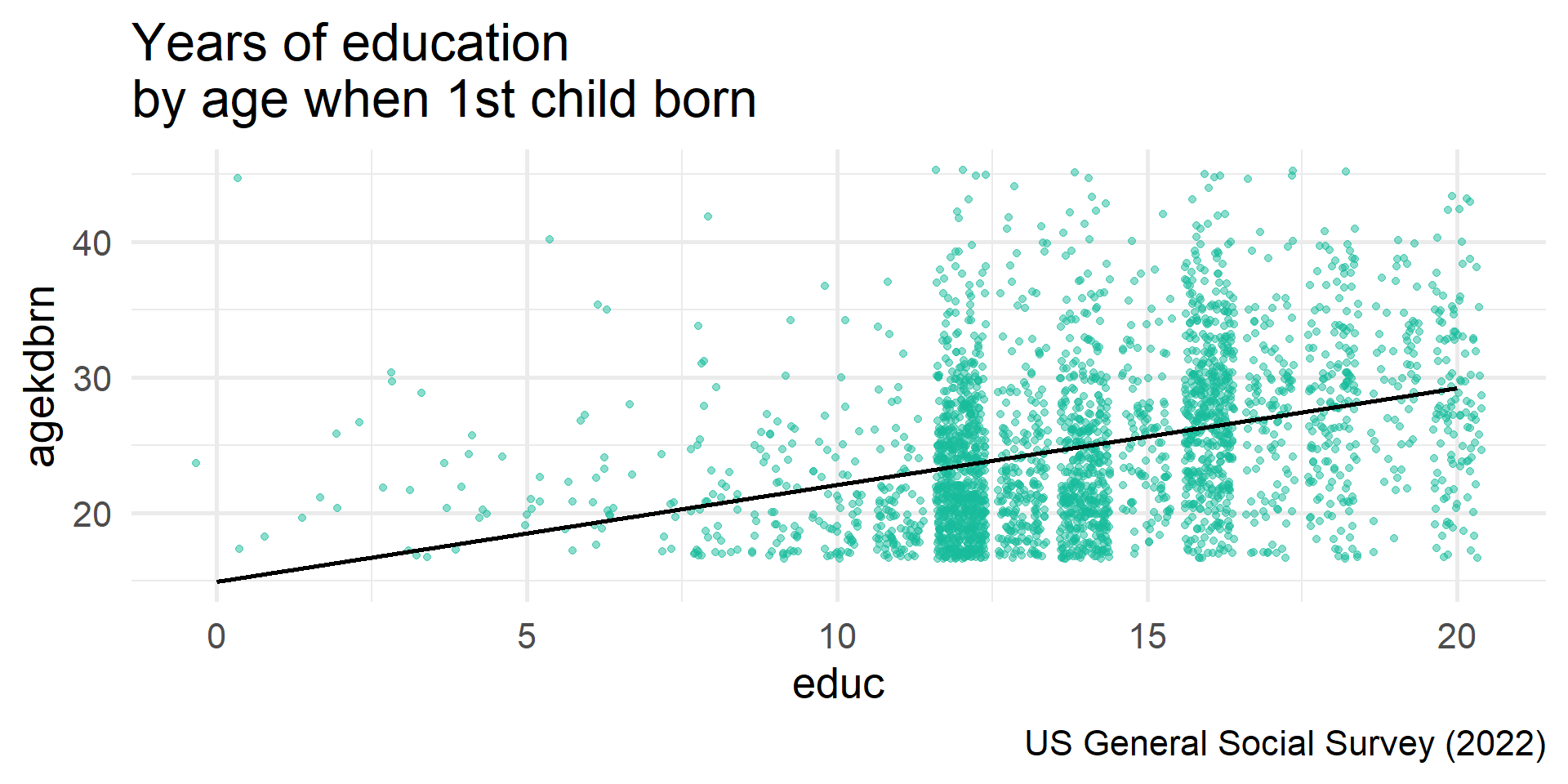
cor.test() in action
    Pearson's product-moment correlation

data:  educ and agekdbrn
t = 19.88, df = 2780, p-value < 2.2e-16
alternative hypothesis: true correlation is not equal to 0
95 percent confidence interval:
 0.3198258 0.3849110
sample estimates:
      cor
0.3527951
Tidy cor.test()
cor.test() & t.test()
Heads Up!
Correlating a dichotomous variable and a continuous variable is equivalent to doing a t-test on that continuous variable by the dichotomous variable.
When x is coded as 0/1, these formulas yield equivalent p-values, even if the t-statistics look slightly different due to rounding or variance assumptions.
# Create numeric version of sex
my_data <- my_data %>%
  mutate(female = if_else(sex == "female", 1, 0))

cor.test(
  ~ female + lifenow,
  data = my_data,
  method = "pearson",
  na.action = na.omit
)
    Pearson's product-moment correlation

data:  female and lifenow
t = -0.85827, df = 2142, p-value = 0.3908
alternative hypothesis: true correlation is not equal to 0
95 percent confidence interval:
 -0.06082662  0.02381053
sample estimates:
        cor
-0.01854126
    Welch Two Sample t-test

data:  my_data$lifenow by my_data$sex
t = 0.85806, df = 2137, p-value = 0.391
alternative hypothesis: true difference in means between group male and group female is not equal to 0
95 percent confidence interval:
 -0.07835816  0.20027032
sample estimates:
  mean in group male mean in group female
7.817837 7.756881 | Feature | t-test | Chi-square test | Pearson’s Correlation (R) |
|---|---|---|---|
| Purpose | Compare means between groups | Test association between categories | Measure linear relationship strength |
| Data Type | Continuous (numeric) | Categorical (nominal or ordinal) | Continuous (numeric) |
| Variables Required | 1 dependent, 1 independent | 2 categorical variables | 2 continuous variables |
| Directionality | One-tailed or two-tailed | Non-directional | Indicates direction (+/-) and strength |
| Example Question | Do men and women differ in time spent on housework ? | Is marital status associated with political party identity? | Is there a correlation between number of children and parental stress? |
Think Like a Statistician
Think Like a Statistician
Are beliefs about premarital sex (premarsx) dependent on political identity (polviews)?
Is there a gender difference (sex) in political identity (polviews)?
Describe the relationship between ageand life satisfaction (lifenow).
Think Like a Statistician
polviews
|
Total | |||||||
|---|---|---|---|---|---|---|---|---|
| extremely liberal | liberal | slightly liberal | moderate, middle of the road | slightly conservative | conservative | extremely conservative | ||
| premarsx | ||||||||
| always wrong | 7 (4.4%) | 19 (5.1%) | 16 (5.2%) | 122 (12%) | 48 (15%) | 103 (28%) | 44 (38%) | 359 (14%) |
| almost always wrong | 6 (3.8%) | 11 (2.9%) | 11 (3.6%) | 55 (5.6%) | 24 (7.3%) | 36 (9.9%) | 11 (9.5%) | 154 (5.8%) |
| wrong only sometimes | 7 (4.4%) | 32 (8.6%) | 33 (11%) | 150 (15%) | 59 (18%) | 57 (16%) | 13 (11%) | 351 (13%) |
| not wrong at all | 139 (87%) | 311 (83%) | 249 (81%) | 657 (67%) | 200 (60%) | 169 (46%) | 48 (41%) | 1,773 (67%) |
| Total | 159 (100%) | 373 (100%) | 309 (100%) | 984 (100%) | 331 (100%) | 365 (100%) | 116 (100%) | 2,637 (100%) |
| Pearson’s Chi-squared test, p<0.001 | ||||||||
sex
|
Total | ||
|---|---|---|---|
| male | female | ||
| polviews | |||
| extremely liberal | 103 (5.5%) | 129 (6.0%) | 232 (5.8%) |
| liberal | 215 (12%) | 347 (16%) | 562 (14%) |
| slightly liberal | 229 (12%) | 247 (12%) | 476 (12%) |
| moderate, middle of the road | 661 (36%) | 848 (40%) | 1,509 (38%) |
| slightly conservative | 267 (14%) | 223 (10%) | 490 (12%) |
| conservative | 298 (16%) | 258 (12%) | 556 (14%) |
| extremely conservative | 83 (4.5%) | 92 (4.3%) | 175 (4.4%) |
| Total | 1,856 (100%) | 2,144 (100%) | 4,000 (100%) |
| Pearson’s Chi-squared test, p<0.001 | |||
    Pearson's product-moment correlation

data:  lifenow and age
t = 7.9037, df = 2031, p-value = 4.402e-15
alternative hypothesis: true correlation is not equal to 0
95 percent confidence interval:
 0.1302456 0.2146032
sample estimates:
      cor
0.1727412